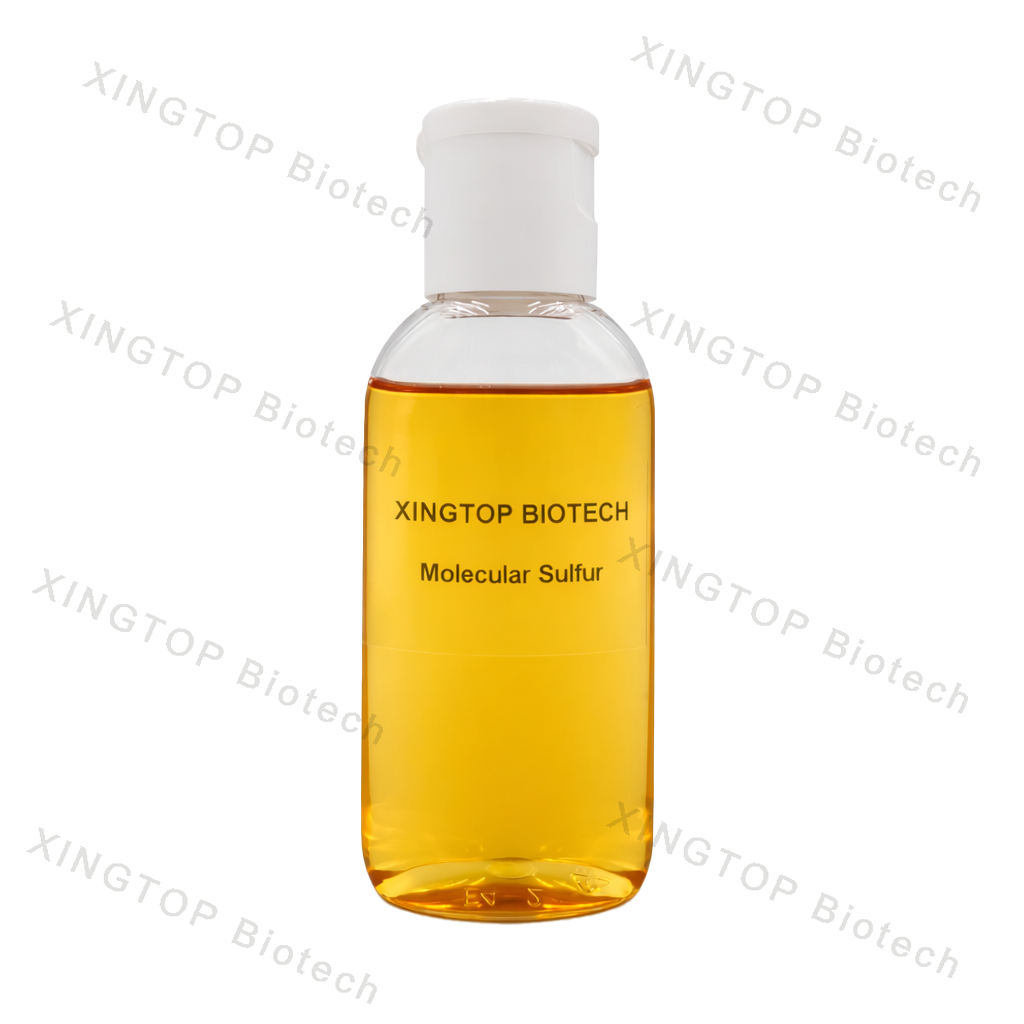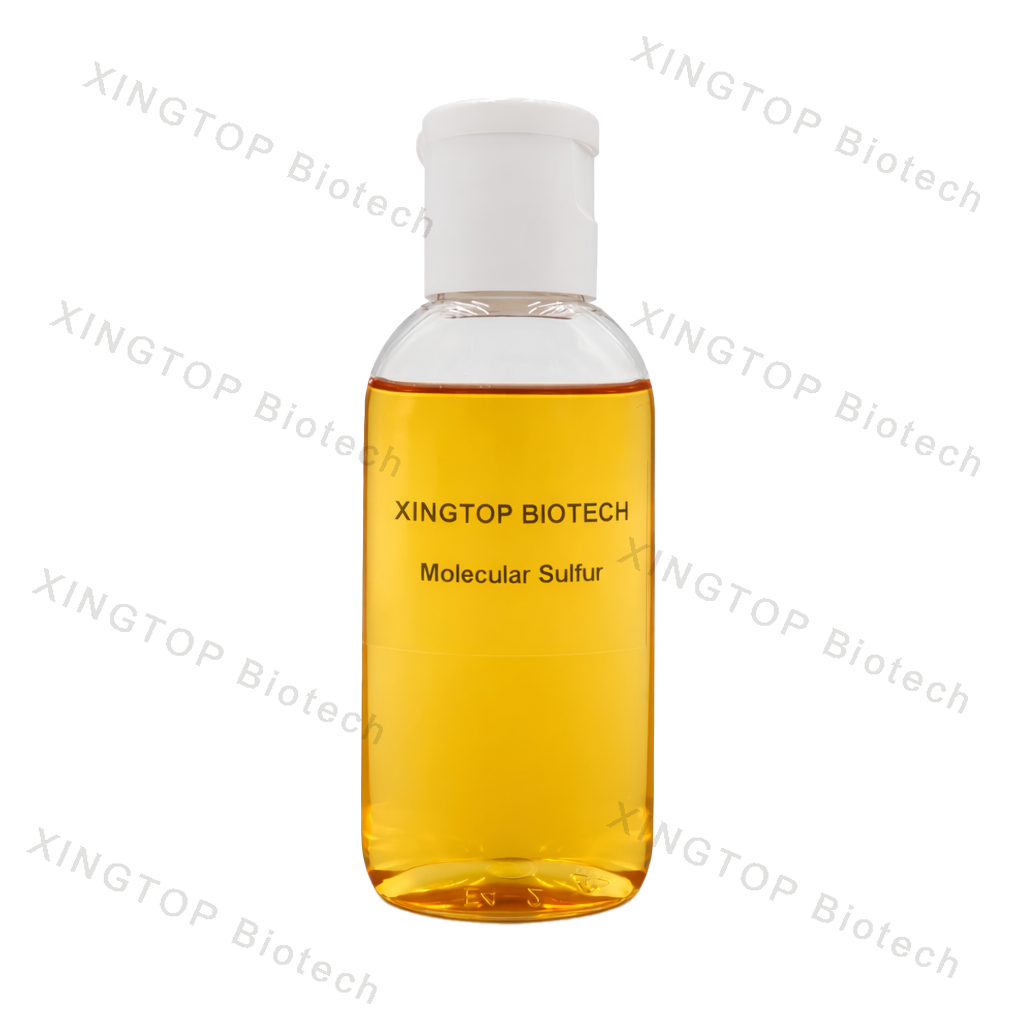

Essential details
Quantity(pieces):5
Volume:0.01 m³
MOQ:5
G.W:5.4 kg
Size:L(19)*W(19)*H(27) cm
N.W:5 kg
Shipping:Air freight, Land transport, Sea freight
Specification Number:007S
Package Description:5
Product Introduction
How Molecular Sulfur Works
- Dispersed at molecular level (no particles)
- Exists between water & oil phases
- Transparent but still highly active
- Enhanced deposition in rinse-off systems
Molecular Sulfur vs Traditional Sulfur
Traditional Sulfur (Sublimed / Colloidal) | Molecular Sulfur | |
Particle Form | Solid particles (1–50 μm / 500 nm) | Molecular-level dispersion |
Particle Count | ~10⁷– 10¹²particles/g | ~10²¹molecules/g |
Dispersion | Poor, uneven | Uniform & stable |
Appearance | Yellow, visible particles | Transparent |
Formulation | Requires suspension system | Easy to formulate |
Residue | Leaves particles | No residue |
Dosage | High | Ultra-low (15–30 ppm) |
Efficiency | Limited utilization | Highly efficient |
Odor | Strong sulfur smell | Mild / reduced odor |
Mechanism of Action of Sulfur
1. Antimicrobial Mechanism:
Sulfur reacts with moisture on the skin or surfaces to form sulfide compounds, which disrupt the cell membrane structure of bacteria and fungi, inhibiting their metabolism and proliferation. It is particularly effective against lipid-dependent microorganisms such as Malassezia and mites.
2. Sebum Control Mechanism:
Sulfide compounds can mildly dissolve excess sebum on the skin and hair surface, while regulating sebaceous gland activity, thereby reducing oil secretion.
3. Cleansing Mechanism:
Sulfur has mild adsorption properties, enabling it to bind oils, dirt, and microbial residues. When combined with surfactants, the overall cleansing performance is significantly enhanced.
4. Deodorizing Mechanism:
Deodorizing is achieved through multiple pathways:
Eliminating odor-causing microorganisms
Adsorbing odor molecules
Breaking down oily residues that act as odor carriers
Limitations of Sublimed Sulfur (Sulfur Powder) in Practical Applications
- Poor dispersion: Large particle size (1–50 μm) leads to uneven distribution in formulations
- Residue and yellow appearance: Leaves visible yellow particles on hair or skin, affecting product aesthetics
- Low stability in formulations: Tends to settle or separate over time
- Limited compatibility: Difficult to incorporate into clear or transparent systems (e.g., clear shampoo, body wash)
- Weak bioavailability: Larger particles reduce effective contact and performance
- Unpleasant odor: Characteristic sulfur smell may affect user experience
Advantages of Molecular Sulfur
Stable · Efficient · Easy to Use
1. Advanced Bicontinuous Phase System
Using a special bicontinuous phase system, sulfur exists in a molecularly dispersed state between the water and oil phases.
Although not truly dissolved, it still delivers a transparent appearance in the final formulation.
2. Excellent Formulation Compatibility
Can be easily incorporated into shampoo, body wash, pet shampoo, laundry detergent, and other formulations, with no obvious sulfur odor in the final product.
3. High Efficiency at Ultra-Low Dosage
At very low levels (15–30 ppm), it can already deliver effective:
- Anti-mite performance
- Anti-acne benefits
- Anti-dandruff effects
- Oil control
4. Enhanced Deposition Technology
Combined with cationic microemulsion flocculation technology, even trace amounts of sulfur can achieve improved deposition and retention in rinse-off products.
Principle of Molecular Sulfur Technology
- Molecular sulfur is developed through a special bicontinuous phase system, in which sulfur is dispersed at a molecular or ultra-fine level between the water and oil phases.
- Unlike conventional sulfur powder, which exists as solid particles, molecular sulfur remains in a highly dispersed and stabilized state within the formulation.
- Although not truly dissolved, this unique structure allows the system to appear transparent, while ensuring effective interaction between sulfur and the skin or scalp.
- In addition, when combined with cationic microemulsion flocculation technology, trace amounts of sulfur can achieve enhanced deposition and retention in rinse-off formulations, improving overall performance even at very low dosage levels.
🧬 Particle Count Comparison of Sulfur Forms
Molecular Sulfur (S₈ form): 1 g of sulfur contains approximately 2.35 × 10²¹ sulfur molecules (S₈)
Colloidal Sulfur (500 nm): 1 g contains approximately 7.38 × 10¹² particles
Sublimed Sulfur (~20 μm): 1 g contains approximately 1.15 × 10⁸ particles
🚀 Key Insight
When sulfur exists in a molecular state, the number of active units is orders of magnitude higher than that of conventional sublimed or colloidal sulfur.
➡️ This leads to:
- Better dispersion in the formulation
- More uniform distribution
- Significantly higher efficiency
Product details